Vietnamese coffee actively cooperates to bring brands to the world
To break through in turnover, the Vietnamese coffee industry is shifting strongly from exporting raw agricultural products to deep processing, building a database of growing areas to meet the European Union Deforestation Regulation (EUDR), actively participating in international auctions, and promoting digital transformation to improve sustainable income for farmers.
Restructuring the value chain and the aspiration to be the "Robusta capital of the world"
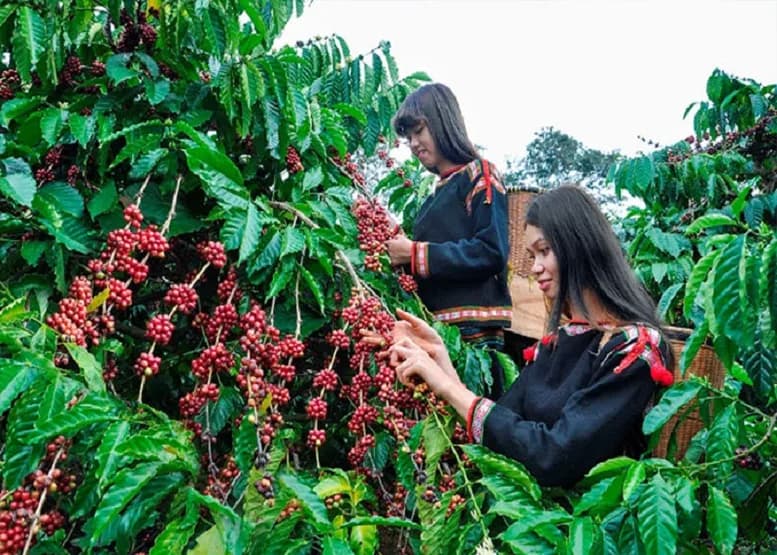
In the export structure of Vietnamese agricultural products, the greatest room for growth currently lies in changing the product mix. Although it is the world's leading Robusta coffee exporter, Vietnam's deep processing rate is currently only at 15-20%, much more modest than Brazil's 45%.
Analyzing the breakthrough orientation, Mr. Le Duc Huy, Chairman of the Member Council of Simexco Dak Lak, affirmed that focusing on deep processing and brand building will bring significant added value. The coffee industry needs to aim for the goal of making Vietnam the "destination of world Robusta", in which Dak Lak province plays the role of the "capital".
Actual operations at Simexco Dak Lak prove that shifting towards developing specialty coffee and participating in auctions can increase the value of green coffee beans by 2 to 3 times.
Through the Climate Resilient Coffee Program (RCP) linked with tens of thousands of farming households in the Central Highlands, applying sustainable farming models helps reduce input costs by 20-30%, increase productivity by 10-15%, and raise farmers' total income on the same area by up to 40%.
Assessing the international stature of Vietnamese coffee, Mr. Daan Wensing, CEO of Stichting IDH (Netherlands), stated that Vietnam's proactive cooperation with Uganda - the two largest Robusta producing nations globally - is an unprecedented precedent. This cooperation creates a solid negotiation position and helps producing countries assert their right to determine the agenda for sustainable development.
Mr. Daan Wensing recommends that Vietnamese enterprises should focus maximally on "domestic value added", bringing final products with high technological content to the market to retain profits domestically. Early compliance with strict standards such as zero deforestation, environmental protection, and ensuring a "living income" for growers will turn green barriers into absolute competitive advantages, making Vietnam a "powerhouse" in the global food system.
From the enterprise perspective, Mr. Le Duc Huy also set a target toward the Net Zero milestone by 2035 and creating additional revenue from carbon credit commercialization.
Cooperating to develop sustainable coffee, bringing the name of Vietnamese coffee to the world
In the Central Highlands, digital transformation and high-tech application are becoming an endogenous motivation helping cooperatives (co-ops) and farmers optimize production costs.
Recently, the People's Committee of Dak Lak province and the Representative Office of Stichting IDH in Vietnam held a ceremony to sign a Memorandum of Understanding on implementing the "Sustainable coffee program adapting to climate change in Dak Lak province, 2026-2030 period".
Mr. Nguyen Thien Van, Vice Chairman of the People's Committee of Dak Lak province, said the locality currently owns more than 217,000 hectares of coffee, which is the core livelihood source for hundreds of thousands of households and brings in nearly 900 million USD in export turnover annually. Dak Lak province expects that through the cooperation framework with IDH, it will expand the scale of sustainable production, improve the quality and added value of products to meet strict standards from international import markets, while attracting more investment resources from the private sector and development organizations.
Mr. Huynh Tien Dung, Chief Representative of IDH Vietnam, said the agreement aims to form a sustainable raw material area of about 75,000 hectares in key areas of the province according to landscape and regional approaches. Cooperation focuses on 4 key objectives: Conserving and using land and water resources effectively in connection with climate change adaptation solutions; Enhancing production capacity, promoting close links between farmers, cooperatives, and enterprises; Building a regional planting database and traceability system that meets the European Union Deforestation Regulation (EUDR); Mobilizing resources and active participation of relevant stakeholders.
Along with the Central Highlands Robusta capital, the Northwest Arabica coffee region is also making an important mark on the international trade map. Mr. Nguyen Thanh Cong, Vice Chairman of the People's Committee of Son La province, informed that the province has reached an agreement with partners on a plan to bring Son La Arabica coffee to the auction floor in Hawaii (USA) in November 2026. The province also aims to bring the product to the national-level coffee auction floor in the second quarter of 2027.
To meet traceability standards and EUDR regulations, Son La province has proactively digitized planting area data, accurately identifying 158,451 coffee plots with a total area of about 65,000 hectares.
Assessing the post-harvest stage, Mr. Nguyen Thanh Cong noted that agricultural product losses could be up to 65% of the value if not preserved and transported well. Son La province requests Central ministries, sectors, and scientists to strengthen support for technology transfer in post-harvest preservation as well as complete logistics infrastructure to protect the value of 65,000 hectares of coffee and more than 85,150 hectares of fruit trees in the locality.