
Completing support policies to create conditions for small and medium-sized enterprises to develop
On the afternoon of October 29, continuing the program of the second session of the 16th National Assembly, delegates discussed in the hall the project of the Law on Small and Medium-sized Enterprises Development (amended).
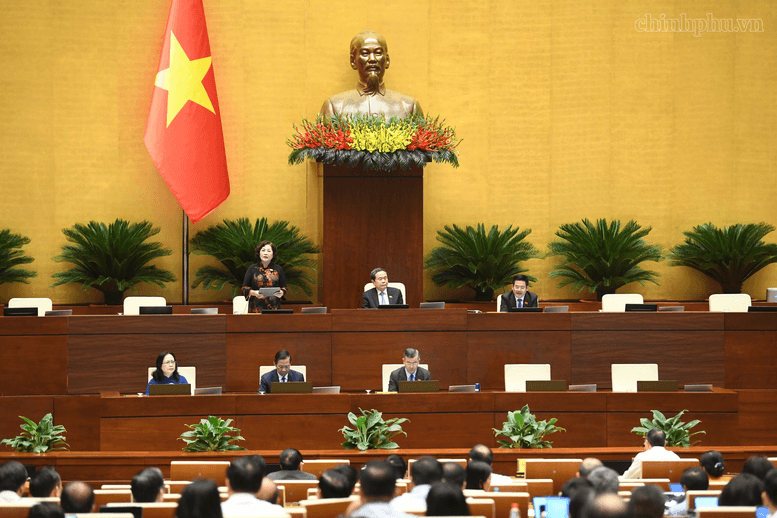
Opinions focused on improving the transition mechanism when reorganizing support funds, clarifying criteria for determining enterprise size, and innovating policy implementation methods to enhance accessibility and benefits for enterprises.
Proposal to ensure the continuity and feasibility of support policies
Delegate Nguyen Thi Viet Nga (Hai Phong city) provided feedback on transition regulations when reorganizing support funds and the method of calculating public procurement targets for small and medium-sized enterprises.
Regarding Article 35 of the draft Law, the delegate proposed clearly stipulating the operational grounds and management responsibilities of the funds during the waiting period for reorganization; distinguishing between continuing to perform loan and guarantee contracts currently in effect and receiving and processing pending applications, applications requiring supplementation, and support needs arising during the transition period.
The merger and dissolution of funds must be linked to the approved transition plan, clearly identifying the entities receiving capital, assets, liabilities, contracts, records, and tasks; stipulating responsibilities and transfer timing to ensure the fulfillment of legal commitments and the resolution of records according to corresponding conditions, authority, and resources. It is proposed that technical procedures be delegated to the Government for detailed regulation.
Regarding Article 12, the delegate proposed standardizing the calculation of public procurement targets based on procurement value as in the draft Law, rather than choosing between the value ratio and the package quantity ratio, as the two calculation methods are fundamentally different. Reserving many very small-value bid packages does not accurately reflect the market opportunities that the policy aims to achieve.
The delegate proposed distinguishing the value of bid packages reserved for small and medium-sized enterprises from the actual contract value awarded. In case the prescribed ratio is not met, there should be grounds for explanation and inspection; the implementing agency must clarify the procurement structure, the reason for the lack of suitable bid packages, and the implementation of priority obligations. The principle of calculating by value, the obligation of transparency and explanation, and the limits on applying exceptions should be established in Article 12; formulas, forms, and implementation procedures should be delegated to the Government for specific regulation.
Regarding criteria for determining enterprise size, delegate Dao Chi Nghia (Can Tho city) argued that short-term fluctuations in revenue and labor could cause enterprise size to change constantly. Meanwhile, the draft does not clearly stipulate how to determine total capital for multi-industry enterprises and newly established enterprises, which could easily lead to different interpretations.
The delegate proposed that the drafting agency not only review the caps of 300 employees, 150 billion VND in capital, and 400 billion VND in revenue but also improve the design of criteria to ensure accurate classification of size, fairness between sectors, and convenience in policy implementation.
Accordingly, it is necessary to study the use of average figures over a suitable period to ensure stability; clearly stipulate the calculation period, data basis, and how to handle cases where enterprises have large fluctuations in capital or revenue. The draft also needs separate regulations for enterprises that have not operated for the prescribed duration and a transition mechanism for enterprises that exceed the threshold while benefiting from policies, to avoid sudden cessation of support.
Delegate Phan Thi Thuy Linh (Thanh Hoa province) highly appreciated the innovative policies in the draft Law, while emphasizing that small and medium-sized enterprises account for over 98% of the total number of enterprises, along with millions of business households, making significant contributions to job creation, ensuring livelihoods, and social stability.
According to the delegates, the progress of support is currently not keeping pace with the upgrading roadmap of businesses. To meet the requirements of major clients, businesses may need 1-2 years to improve production, while support activities are often concentrated in the last 6 months of the fiscal year, mainly focusing on consulting, training, and participating in trade fairs. Content such as trial production and testing has not been widely implemented.
Citing data from the Ministry of Finance's summary report, the delegate stated that in a survey of nearly 500 small and medium-sized enterprises (SMEs), only about 9% responded that they had accessed and benefited from support policies. Therefore, it is necessary to strongly innovate the method of implementation so that policies can truly reach businesses.
The delegate suggested that the selection of organizations to implement policies must be public, transparent, and in accordance with regulations; payments should be linked to acceptance results. In addition to building appropriate policies, there must be an effective implementation mechanism so that businesses are aware of, can access, and benefit from these policies.
Clarification of classification criteria and support policies
Regarding the criteria for defining small and medium-sized enterprises, Minister of Finance Ngo Van Tuan stated that the draft stipulates an average number of employees not exceeding 300, a maximum total capital of 150 billion VND, or a maximum revenue of 400 billion VND.
According to the Minister, these levels were developed on the basis of inheriting previous regulations while taking into account GDP growth rates and inflation indices from 2017 to the present. The drafting agency also consulted international experience, worked with the Association of Small and Medium Enterprises, the International Finance Corporation (IFC), the OECD, and several other countries. The draft entrusts the Government with specifying criteria suitable for each industry and sector.
Regarding support policies, the draft designs 11 general support policies and 4 targeted support policies. The tax support policy for 3 years from the date the business is licensed is inherited from National Assembly Resolution No. 198/2025/QH15 issued in 2025, aimed at creating conditions for newly established businesses to adapt, survive, and develop.
Regarding site access, the draft expands the policy in the direction of allowing local governments to invest in industrial park and industrial cluster infrastructure to reserve land funds for small and medium-sized enterprises. According to statistics from the Ministry of Finance, since Resolution No. 198/2025/QH15 took effect, 110 industrial parks have reserved land funds with complete infrastructure to attract this group of businesses.
Regarding public procurement, according to the Minister, the policy reserves at least 20% of public procurement funds for small and medium-sized enterprises, prioritizing bidding packages valued at 20 billion VND or less. In nearly one year of implementation, nearly 226,000 bidding packages under 20 billion VND were reserved for SMEs, with more than 12,000 businesses participating, totaling approximately 126 trillion VND in value.
The Minister also stated that the reduction of administrative procedures has helped reduce compliance time by 53% and costs by 54%. The draft continues to aim for further reductions in legal compliance time and costs, encouraging small and medium-sized enterprises to apply information technology, big data, and artificial intelligence.
Regarding the handling of outstanding tax identification numbers, there are currently about 2.8 million inactive tax codes, of which about 1.2 million belong to businesses and business branches. In the first 8 months of 2026, tax authorities closed nearly 600,000 tax codes. The Ministry of Finance is studying specific policies, including matters under the authority of the National Assembly, to handle these tax codes.